
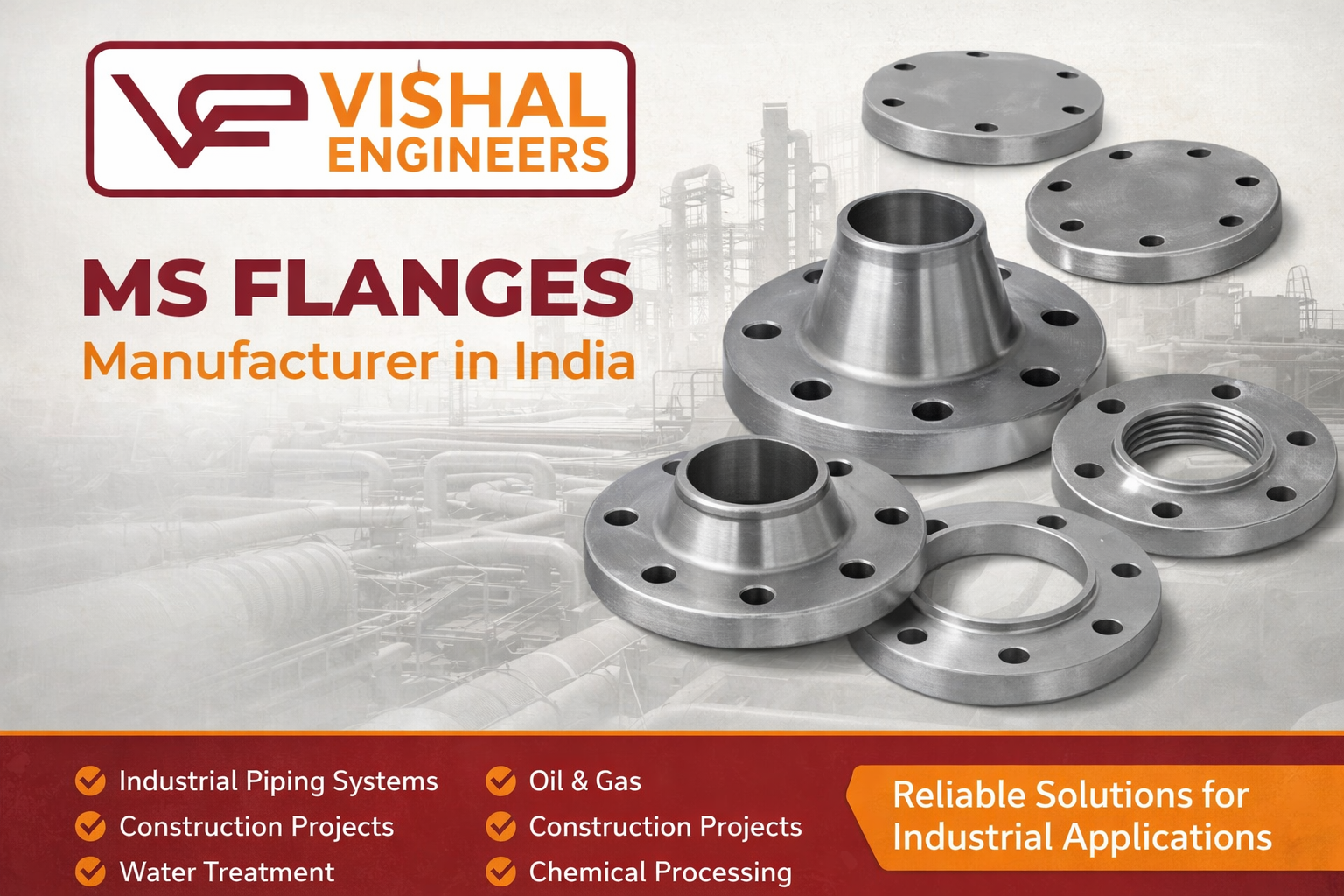
MS Flanges
Manufacturer
in India
Mild steel flanges play an essential role in modern piping infrastructure, where secure and durable pipe connections are necessary for safe fluid transfer and system integrity. Across industrial facilities, construction projects, energy plants, and manufacturing environments, piping networks require reliable mechanical connections capable of withstanding pressure, vibration, and long-term operational stress.
An MS flanges manufacturer in India supplies mild steel flanges that function as critical connecting components in piping systems used to transport liquids, gases, and various industrial materials. These flanges allow pipes, valves, pumps, and equipment to be joined securely while also enabling systems to be assembled, maintained, or dismantled when required.
Mild steel provides a balanced combination of strength, machinability, and cost efficiency, making it one of the most widely used materials in industrial flange manufacturing. The versatility of MS flanges allows them to be applied across multiple industries where structural durability and reliable system performance are essential.
Understanding MS Flanges in Industrial Piping Systems
MS flanges, commonly referred to as mild steel flanges, are circular or square mechanical components designed to connect pipes and equipment within piping systems. They form secure joints between pipe sections while allowing proper alignment and sealing.
These flanges typically feature bolt holes around their perimeter, enabling them to be fastened using bolts and nuts with a gasket placed between the flange faces. The gasket provides a leak-resistant seal when the system operates under pressure or varying temperature conditions.
Within industrial piping infrastructure, MS flanges act as connection points that allow piping systems to be assembled in a modular manner. This design makes inspection, maintenance, and replacement of pipeline sections significantly easier compared with permanently welded connections.
The widespread use of mild steel flanges across industrial systems reflects their ability to deliver dependable performance in diverse operating environments where mechanical strength and cost efficiency are both important.
Common Types of Mild Steel Flanges
Different industrial piping applications require different flange configurations. Each type of flange is designed to meet specific connection, pressure, or installation requirements within piping systems.
Common types of MS flanges include:
- Weld Neck Flanges – Designed with a long tapered hub that provides strong reinforcement for high-pressure applications.
- Slip-On Flanges – Installed by sliding the flange over the pipe and welding it into position.
- Socket Weld Flanges – Commonly used for smaller pipe diameters where smooth internal flow is required.
- Threaded Flanges – Designed with internal threads that allow connection without welding.
- Blind Flanges – Used to seal the end of piping systems for maintenance, inspection, or future expansion.
Each flange design supports specific operating conditions, providing flexibility when designing piping networks across industrial plants and infrastructure projects.
Manufacturing Process of MS Flanges
The manufacturing of mild steel flanges involves several engineering processes to ensure dimensional accuracy, mechanical strength, and compatibility with piping systems.
The process typically begins with the selection of suitable mild steel materials that meet required industrial standards. Steel billets or plates are then shaped into flange forms through forging, machining, or fabrication depending on the required type and size.
Precision machining operations are performed to create bolt holes, sealing surfaces, and accurate flange dimensions. These machining processes ensure proper alignment with connecting pipes and associated equipment.
Quality inspection is an essential stage in the production of MS flanges. Dimensional verification, material testing, and surface finishing checks help confirm that each flange meets operational requirements before being used in industrial piping systems.
Industrial Applications of MS Flanges
MS flanges are widely used in industries where piping systems are required for transporting fluids, gases, or process materials. Their ability to provide secure connections and convenient maintenance access makes them suitable for a wide range of applications.
Typical applications include:
- Industrial piping systems
- Construction and infrastructure projects
- Oil and gas processing facilities
- Water treatment and distribution systems
- Chemical processing plants
- Manufacturing units and factories
- Power generation installations
The adaptability of mild steel flanges enables them to support both low-pressure and moderate-pressure piping networks across numerous industrial sectors.
Role of MS Flanges in Structural and Fabrication Projects
In addition to conventional piping systems, mild steel flanges are also used in structural fabrication and engineering projects. In heavy fabrication environments, flanges can serve as mounting components or connection points for mechanical assemblies and industrial equipment.
Structural steel fabrication projects often require modular assembly techniques that allow equipment or steel frameworks to be installed efficiently. MS flanges provide a practical solution for joining components while maintaining proper structural alignment.
Because mild steel is relatively easy to machine and fabricate, it supports custom flange designs tailored to the requirements of specific engineering applications. This flexibility contributes to the widespread use of MS flanges in fabrication workshops and industrial manufacturing facilities.
Factors to Consider When Selecting MS Flanges
Selecting the correct type of mild steel flange is important to ensure safe and efficient piping system performance. Engineers typically evaluate several technical factors when choosing flanges for a particular application.
Important considerations include:
- Pipe size and flange dimensions
- Pressure rating of the piping system
- Temperature conditions during operation
- Type of fluid or gas being transported
- Flange face type and gasket compatibility
- Installation method, such as welding or threading
Careful evaluation of these parameters helps ensure that the selected flange performs reliably within the operating conditions of the piping system.
Importance of Precision Engineering in Flange Manufacturing
Flange manufacturing requires strict dimensional accuracy to ensure proper alignment between pipe sections and equipment connections. Even minor deviations in bolt hole spacing, flange face finish, or diameter can lead to leakage or connection failure within a piping system.
Precision engineering techniques enable manufacturers to maintain consistent tolerances during machining and fabrication processes. Accurate bolt hole positioning ensures that flanges can be assembled efficiently without alignment problems during installation.
Additionally, smooth sealing surfaces improve gasket performance, reducing the risk of leakage in industrial pipelines. These manufacturing standards play an important role in maintaining safety and operational reliability across industrial piping networks.
Maintenance Considerations for Flanged Piping Systems
Piping systems that utilize flange connections require periodic inspection to ensure safe and reliable long-term operation. Regular maintenance checks help identify potential issues such as gasket wear, bolt loosening, or corrosion around flange joints.
During routine inspections, technicians verify that bolts remain properly tightened and that sealing surfaces remain free from damage. If maintenance or replacement is required, flange connections allow pipe sections to be removed and reassembled without extensive cutting or welding.
This modular maintenance capability is one of the key advantages of using flanged connections in industrial piping infrastructure.
Future Demand for MS Flanges in Industrial Infrastructure
Industrial development continues to expand across sectors such as energy production, manufacturing, infrastructure construction, and water management. As these industries grow, the demand for durable piping components such as MS flanges continues to increase.
Modern industrial facilities require piping systems that can be assembled efficiently while maintaining high standards of reliability and safety. Mild steel flanges provide an effective solution due to their strength, fabrication flexibility, and compatibility with multiple piping configurations.
The continued expansion of industrial projects, process plants, and engineering infrastructure ensures that MS flanges will remain an important component within piping and fabrication systems for years to come.
Frequently Asked Questions
Common questions about MS flanges and mild steel flange manufacturing.
Filter Using Product Tags
About Us
Vishal Engineers is an esteemed engineering company that excels in design, construction, and project management. With over two decades of experience, we specialize in delivering innovative solutions across diverse sectors such as infrastructure, energy, and manufacturing. Our dedicated team of professionals ensures timely project completion while adhering to the highest quality standards and budget constraints. We prioritize client satisfaction through transparent communication and collaborative approach. From conceptualization to execution, Vishal Engineers stands as a trusted partner in turning ambitious ideas into reality, contributing to the advancement of engineering excellence.
Get Connected With Us:
Request a Quote
Fill all information details to consult with us to get sevices from us
Get in touch
You will find yourself working in a true partnership that results in an incredible experience, and an end product that is the best.
 Inquiry